Showing posts with label toilets. Show all posts

Monday, 4 January 2016

Building Toilets, Saving Lives

By Nick Baker, Communication and Knowledge Management Officer

Vikensa Hamakonda’s future is a little brighter. ©UNICEF Indonesia/2015/Nick Baker

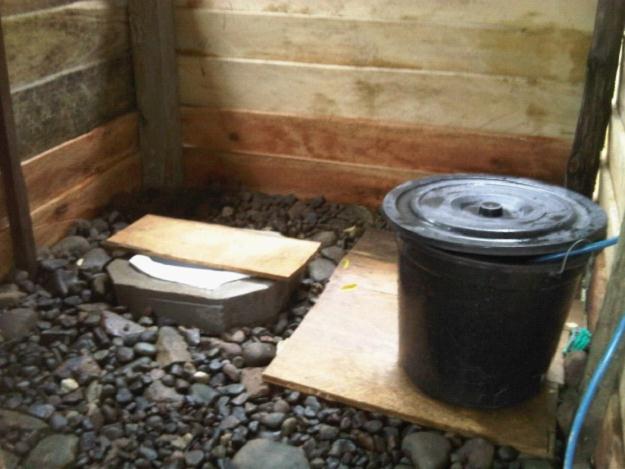
Ten-month-old Vikensa Hamakonda looks curiously at the latest addition to his family home. It’s an outdoor toilet built from bamboo and tin. But this simple structure may end up saving Vikensa’s life.

On the island of Sumba (NTT), open defecation has been an accepted practice for as long as most people here can remember. Unbeknownst to many, this is endangering the lives of countless children in the region.

The pathogens from faeces left in the open can easily enter a community’s food and water chain. This leads to a raft of health problems, which particularly affect children.

Around Sumba there are stories of young children dying from diarrhea  – which can be caused by poor sanitation.  It also impacts on their growth as poor sanitation is linked to high rates of malnutrition.

UNICEF is supporting a number of programmes to end open defecation in Sumba. One of these is helping local health workers to hold “triggering sessions”. Triggering sessions are health and sanitation workshops that are conducted in individual villages. They involve dramatic demonstrations of how faeces in the open can make children sick.

A triggering session was recently held at Vikensa’s village. His father, Letu, attended. “It was a very powerful experience,” he says. “I learnt how germs from faeces from outside my house could get back into my family’s food.” The final message was simple: build and use a toilet.

The event had a lasting impact on Letu. Previously, his family would defecate in a small area behind their house. But not anymore. Letu has built a toilet. And many other villagers are doing the same.

This means that children like Vikensa will help get the best possible start to life.

Thursday, 31 July 2014

Check list for a healthy life

By Nova Fransisca Silitonga, Corporate Partnership Officer, UNICEF Indonesia

Have you washed your hands with soap? Had breakfast? Brushed your teeth? Pooed in the loo? Cleaned your ears?

These are some of the questions pupils at Elementary School SDN 69 in Galesong village, Takalar District, South Sulawesi have to answer every morning.

Their teachers ask them to fill in a wall chart to show which activities they’ve completed, and which they haven’t. The exercise is designed to encourage pupils to be honest while also teaching them how to have a healthy lifestyle.

Tuesday, 26 March 2013

A visionary, a farmer - and a healthy village: how Galung put an end to open defecation

Despite is location just 17 kilometres from the district capital, Galung is an under-developed village in Kecamatan Barru, in the Indonesian province of South Sulawesi. 


Simple family latrine built in Galung Village
© UNICEF Indonesia / Gerber
140 families out of a total 484 households in the village haven’t had access to proper latrines for some time, although efforts have been made to promote better hygiene in the village. However, demand for proper sanitation has been high, frustrated mainly by low incomes prevention the construction of latrines. Despite that challenge, Galung has just been declared the first village in the district to be “open-defecation free” – meaning no families go to the toilet in the open.

This success has been determined by the fact that the village head has great interest in sanitation, and there is a creative local entrepreneur/village artisan who has been able to build cheap latrines. 

Friday, 8 March 2013

The dark of day: life in a Jakarta urban slum

In the mornings, Neng helps her mum on the family food stall
© UNICEF/Indonesia 2012/Andy Brown
Neng is fourteen years old. She lives and works on Venus Alley, a lane in the notorious Jembatan Besi slum in Jakarta, Indonesia. Unlike other children her age, she rarely gets to see the sun. The slum is one of the most densely populated in Indonesia, rising to four stories in places. The ground floor homes are reasonably well constructed but as they ascend, they become increasingly makeshift, with walls and floors made from wood and scrap metal.