Monday, 5 June 2017

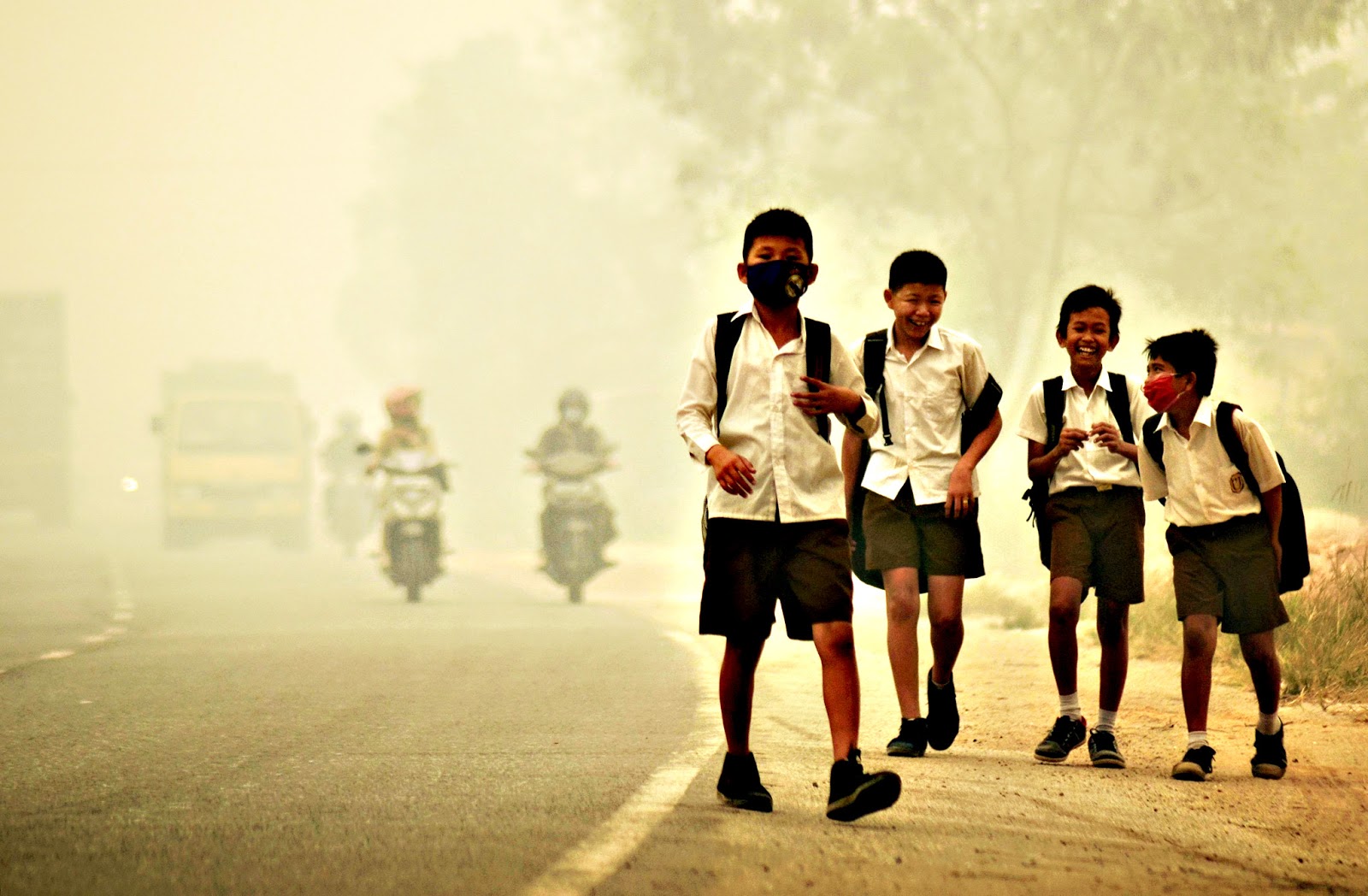
Pushing Haze Safety for Indonesian Kids

By: Vania Santoso – Innovations Adolescent and Youth Engagement Officer

Students walk along a street as they are released from school to return home earlier due to the haze in Jambi, Indonesia’s Jambi province © Antara Foto/Wahdi Setiawan/Reuters/29 September 2015

Palangkaraya: “Haze made me feel like I don’t want to be here anymore, ever!” said Gibran, a fourth-grader from Palangkaraya, East Kalimantan.

It wasn’t easy to listen to Gibran recount life during the 2015 haze in his corner of Indonesian Borneo, a weekslong event some have called the 21st century’s worst environmental disaster. In his village, the haze got so bad he and his family couldn’t stay. They were evacuated hundreds of kilometres away to Java, where they stayed for some two months with his grandmother.

Helping Jasmine

By: Felice Bakker, JPO, Child Protection

As part of UNICEF Indonesia’s approach to modelling scalable interventions, I am documenting good birth registration practices at our nine pilot sites across Indonesia.  On this occasion, I was able to meet with a family who benefited from UNICEF’s pilot in Makassar, where partnerships are facilitated with local NGO’s to register vulnerable children, including those with disabilities.

Jasmine (left) poses with the author (center), her two children and friend Irma at home in Makassar
Makassar: Jasmine* is quadriplegic. So are her two youngest children. Her three-year-old daughter Nur needs to be carried, while her five-year-old son Ali has to walk on all fours.

During antenatal visits to hospitals in years past, doctors told Jasmine that a disabled mother couldn’t possibly raise children the right way, advising her to use contraceptives to avoid future pregnancies. Needless to say, Jasmine disagreed.

To learn more about Jasmine’s life as a mother with disability and the challenges she faces, a colleague and I visited her at her home in Makassar, South Sulawesi. She greeted us warmly at the door, inviting us inside to meet her three children, whose laughter could already be heard from the street.

Friday, 2 June 2017

Empowering midwives with INFOBIDAN

By Cory Rogers, Communication Officer

Two midwives demonstrate how to access the information held on the INFOBIDAN website. © Cory Rogers / UNICEF / 2017

East Java: “With INFOBIDAN, we have the proof at our fingertips!” hollers Sri Utami, a village-based midwife in eastern Java, just making herself heard above the noise.

Steps away, seven women lead a boisterous chant – “INFOBIDAN, yes! INFOBIDAN yes!” – hoping to have already convinced the 100 midwives who have gathered to sign up for the new mobile application.

Thursday, 1 June 2017

#IniSuaraku: What Young People Think about Access to Reproductive Care

By Vania Santoso, Youth Engagement Officer

Young people got busy on their mobile phones to voice their opinions during the Adolescent Summit © UNICEFIndonesia/2017/Achmad Rifai

Yogyakarta: Each year, 1 June marks the Global Day of Parents, a day emphasizing the critical role of parents in the rearing of children. Children need to be nurtured and protected; no child should be a parent.

Thinking about this made me recall my experience at the National Adolescent Summit in Yogyakarta in March 2017 which aimed to address the issue of unplanned teen pregnancy.  

Some 70 young people, selected from 25 of Indonesia's 34 provinces, engaged in intense discussions on adolescent reproductive health access with representatives from the Government of Indonesia, UN agencies and NGOs. 

Naturally, in the "Twitter Capital of the World", debates spilled over onto social media. It was amazing to see young people boldly voicing their opinions and taking a stand on these sensitive issues, both online and offline. 

Wednesday, 31 May 2017

Sweden's Queen Silvia puts Indonesian children front and centre

By Cory Rogers, Communication Officer

Sweden’s Queen Silvia accepts a “Dream Map” describing the aspirations of nine youngsters during her state visit to Indonesia on May 24th, 2017.
© Cory Rogers/UNICEF / 2017.

Jakarta: “I want to be the first Indonesian to touch the moon!” proclaimed Ikhsan, a fifth-grade boy from the crowded neighbourhood of Manggarai, South Jakarta.

Sitting nearby, Her Majesty Queen Silvia of Sweden must have seemed an unlikely visitor to this urban slum, where children often lack the residency papers to attend primary school, let alone pursue a degree in something like astrophysics.

“I want to become an astronaut!” Ikhsan continued, peppering his Bahasa Indonesian with a healthy dose of English. “But here, not many children even know what astronomy is.”

How might the Queen help kids like him realize such a dream? he wondered. And what might Indonesia be able to do?